How to Plan Content for 30 Days
One of the biggest struggles every Content Creator faces is deciding what to post every day.
You wake up.
Open Instagram.
Think for a few minutes.
Search for ideas.
Watch other creators.
And eventually ask yourself,
"What should I post today?"
This daily struggle wastes valuable time and often leads to inconsistent posting.
Successful creators rarely think about today's content.
They've already planned it.
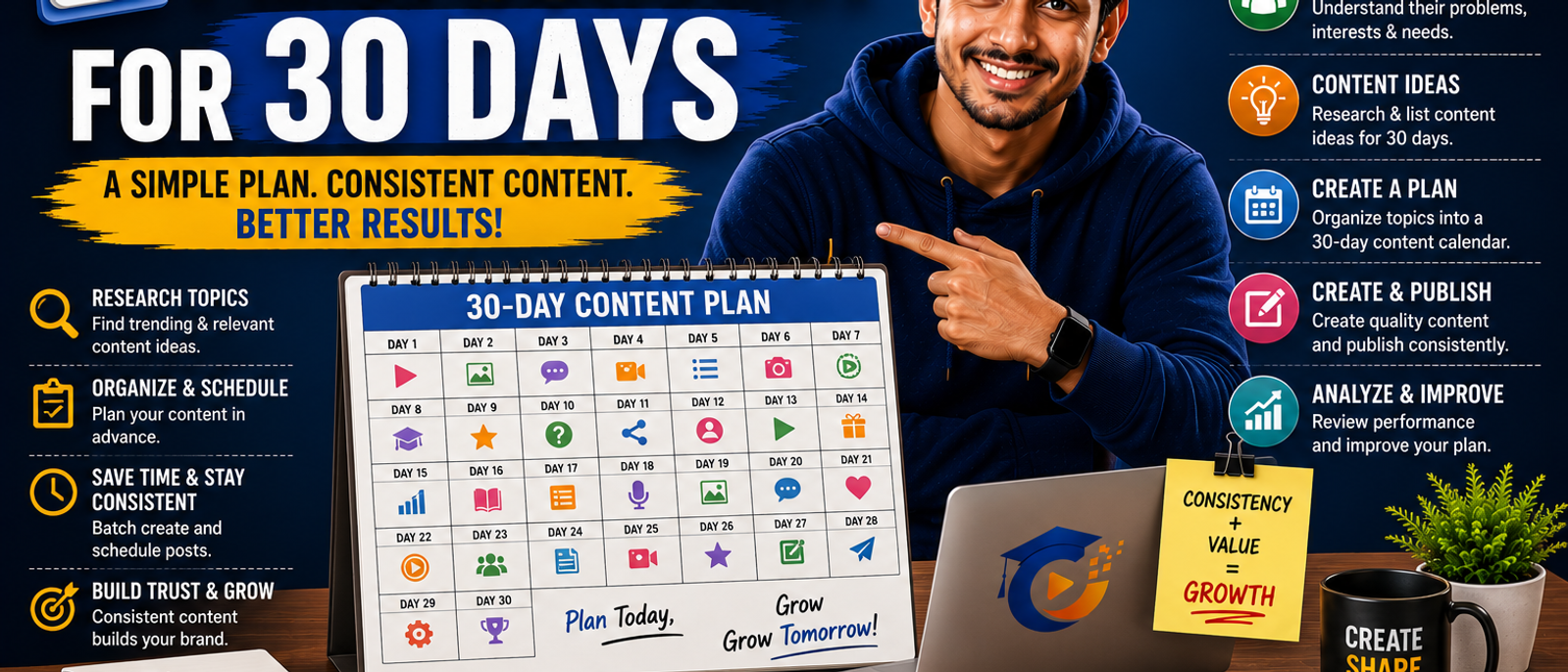
That's the power of a 30-Day Content Plan.
Instead of creating one post at a time, you prepare an entire month's worth of content in advance.
This helps you stay consistent, reduce stress, improve quality, and focus more on creating instead of constantly thinking about new ideas.
In this guide, you'll learn a simple framework to plan 30 days of content, even if you're a complete beginner.
If you're just starting your Content Creation journey, we recommend reading these guides first:
How to Become a Content Creator
https://www.creatorscollege.in/blog/how-to-become-a-content-creator-a-complete-beginner-s-guide-202
What Is Content Creation?
https://www.creatorscollege.in/blog/what-is-content-creation-a-complete-beginner-s-guide-2026
How to Create a Content Strategy
https://www.creatorscollege.in/blog/how-to-create-a-content-strategy-2026-complete-guide
Complete Content Creation Roadmap for Beginners
https://www.creatorscollege.in/blog/complete-content-creation-roadmap-for-beginners-2026-step-by-step-guide
These guides will help you understand the Content Creation process before planning your monthly content.
Quick Answer: How Do You Plan Content for 30 Days?
Plan your content by choosing your content pillars, researching audience questions, creating a monthly content calendar, writing scripts in batches, recording multiple videos together, editing them efficiently, and scheduling your posts in advance. A structured plan saves time and improves consistency.
Why You Should Plan Content in Advance
Creating content every day without a plan quickly becomes exhausting.
Planning ahead gives you several advantages.
You can:
- Stay consistent.
- Save hours every week.
- Reduce creative stress.
- Produce higher-quality content.
- Maintain a regular posting schedule.
- Focus on improving your content instead of searching for ideas.
Professional Content Creators don't rely on daily inspiration.
They rely on preparation.
Step 1 – Define Your Monthly Goal
Before creating your content calendar, ask yourself one question.
"What do I want to achieve this month?"
Your goal could be:
- Build your personal brand.
- Increase Instagram engagement.
- Grow YouTube subscribers.
- Generate business inquiries.
- Educate your audience.
- Promote your services.
- Build trust.
Having one clear goal helps every piece of content work together.
Step 2 – Choose Your Content Pillars
Content Pillars are the main topics you'll consistently create content around.
For example, if your niche is Content Creation, your pillars might include:
- Content Planning
- Script Writing
- Mobile Video Shooting
- Video Editing
- Instagram Growth
- Personal Branding
- AI Tools
- Creator Mindset
These pillars become the foundation of your monthly calendar.
Instead of creating random videos, every post now has a purpose.
Step 3 – Brainstorm 30 Content Ideas
Now it's time to generate ideas.
Start by asking:
- What questions does my audience ask?
- What beginner mistakes can I explain?
- Which topics are trending?
- What problems can I solve?
- Which myths can I clarify?
Don't judge your ideas while brainstorming.
Simply write everything down.
Your goal is quantity first.
Quality comes later.
Most creators are surprised by how quickly they can generate 30 or even 50 content ideas once they begin thinking about audience problems instead of random topics.
Step 4 – Organize Your Content Calendar
Now place your ideas into a monthly calendar.
For example:
Monday – Educational Tip
Tuesday – Beginner Mistake
Wednesday – Tutorial
Thursday – Behind the Scenes
Friday – Frequently Asked Question
Saturday – Case Study
Sunday – Motivation or Creator Mindset
Having a repeatable weekly structure makes planning much easier.
It also helps your audience know what type of content to expect.
Step 5 – Prioritize Evergreen Content
Not every post needs to follow current trends.
Focus primarily on evergreen content.
Evergreen content remains useful months or even years after it's published.
Examples include:
- Beginner Guides
- Tutorials
- Step-by-Step Processes
- FAQs
- Tips
- Common Mistakes
- Educational Content
Evergreen content continues attracting viewers long after publication.
That's one reason it performs so well for SEO and long-term audience growth.
Step 6 – Write Scripts in Batches
Instead of writing one script every day, dedicate one day to scripting.
For example, write scripts for:
- 5 Reels
- 5 YouTube Shorts
- 2 Long-form Videos
Batch scripting improves consistency and keeps your ideas connected.
It also saves significant time throughout the month.
Step 7 – Batch Record Your Content
Recording multiple videos together is one of the biggest productivity hacks used by professional creators.
Instead of setting up your camera every day, record several videos in one session.
Benefits include:
- Saving time.
- Maintaining consistency.
- Reducing setup effort.
- Improving confidence in front of the camera.
One recording session can often provide content for an entire week or even longer.
Step 8 – Batch Edit Your Videos
Editing works best in batches too.
Instead of switching between recording, editing, and publishing every day, dedicate one editing session for multiple videos.
This improves efficiency because you stay focused on one task.
Professional creators don't multitask.
They build systems.
Step 9 – Schedule Your Content
Creating content is important.
Publishing it consistently is even more important.
Instead of uploading videos manually every day, create a publishing schedule.
For example:
- Monday – Educational Reel
- Tuesday – Beginner Tip
- Wednesday – Tutorial
- Thursday – Behind the Scenes
- Friday – Frequently Asked Question
- Saturday – Success Story
- Sunday – Creator Mindset
A publishing schedule removes guesswork and keeps your audience engaged.
Consistency builds familiarity.
Familiarity builds trust.
Step 10 – Repurpose Your Content
One content idea should never be used only once.
Successful creators maximize every piece of content.
For example:
One YouTube video can become:
- 3 Instagram Reels
- 3 Facebook Videos
- 5 Instagram Stories
- 1 Blog Article
- Carousel Posts
- Quote Graphics
- YouTube Shorts
This saves time while allowing you to reach different audiences across multiple platforms.
Create once.
Publish many times.
Step 11 – Track Your Performance
At the end of every month, review your content.
Ask yourself:
- Which videos received the most views?
- Which posts generated the most comments?
- Which content was shared the most?
- Which videos were saved?
- Which topics attracted new followers?
- Which posts generated enquiries?
Your audience tells you what they enjoy.
Use this information to improve your next month's content plan.
Never guess.
Always learn from data.
Step 12 – Update Your Next 30-Day Plan
Content planning is a continuous process.
Every month should be slightly better than the previous one.
Review:
- Your best-performing topics.
- Audience questions.
- Trending discussions.
- Frequently requested tutorials.
- Content that generated enquiries.
Then create your next 30-day calendar based on these insights.
Small improvements every month create massive results over time.
Sample 30-Day Content Workflow
Here's a simple monthly workflow beginners can follow.
Week 1
- Research content ideas.
- Finalize 30 topics.
- Organize your content calendar.
Week 2
- Write scripts for the entire month.
- Prepare recording setup.
- Gather required resources.
Week 3
- Record multiple videos.
- Edit all content.
- Create thumbnails and captions.
Week 4
- Schedule posts.
- Publish consistently.
- Review performance.
- Plan the following month.
Following this workflow helps you stay organized while reducing stress.
Common Mistakes While Planning Monthly Content
Many beginners struggle because they make these common mistakes.
Planning Only One or Two Days Ahead
Daily planning creates unnecessary pressure.
Always plan weeks in advance.
Depending on Daily Motivation
Motivation changes.
Systems don't.
Build a schedule instead of relying on inspiration.
Creating Random Content
Every post should support your overall Content Strategy.
Avoid posting unrelated topics simply because they're trending.
Ignoring Audience Questions
Your audience provides endless content ideas.
Listen carefully to comments and messages.
Never Reviewing Performance
Posting without analyzing results means missing valuable learning opportunities.
Review every month.
Improve every month.
Tips to Stay Consistent
Consistency becomes much easier when you simplify your workflow.
Here are a few practical tips:
- Keep one dedicated day for planning.
- Write scripts in batches.
- Record multiple videos together.
- Edit videos in batches.
- Prepare captions before publishing.
- Schedule posts whenever possible.
- Keep a notebook or digital document for new content ideas.
Remember:
Planning saves far more time than it takes.
Frequently Asked Questions
Is planning 30 days of content too much for beginners?
Not at all.
Planning doesn't mean creating everything in one day.
It simply means deciding what you'll create before the month begins.
How many content ideas should I prepare?
Aim for at least 30 ideas.
Having extra ideas is always better than running out of topics halfway through the month.
Should every post be educational?
No.
A healthy content mix may include:
- Educational Content
- Tutorials
- FAQs
- Behind-the-Scenes
- Case Studies
- Personal Experiences
- Success Stories
- Motivational Posts
Variety keeps your audience engaged.
Can I use the same content on multiple platforms?
Yes.
Repurposing content is one of the smartest ways to save time and reach more people.
Just optimize the format for each platform.
How often should I update my content calendar?
Review and update your content calendar every month based on audience feedback and performance.
Creator's Perspective
By Cecil Srungarapati
One habit that completely changed the way I create content was planning ahead.
In the beginning, I used to think about content every single day.
It was stressful.
Some days I had ideas.
Some days I didn't.
That changed when I started creating a monthly Content Plan.
After working on 2,000+ business content projects, I've learned that consistency isn't created by motivation.
It's created by systems.
At Creators College, we teach students to think like professionals.
Research first.
Plan ahead.
Write scripts.
Batch record.
Batch edit.
Publish consistently.
Review performance.
Repeat.
When you follow this workflow, Content Creation becomes far more enjoyable and much less overwhelming.
Final Thoughts
Planning 30 days of content doesn't limit creativity.
It actually gives you more freedom.
Instead of worrying about what to post tomorrow, you can focus on creating better content today.
Choose your monthly goal.
Research audience problems.
Create your content calendar.
Write scripts.
Batch record.
Batch edit.
Schedule your content.
Review your performance.
Then improve the process next month.
Great Content Creators don't rely on last-minute ideas.
They rely on preparation.
The better your planning, the easier your Content Creation journey becomes.
Related Articles
Continue learning with these beginner-friendly guides:
How to Become a Content Creator
https://www.creatorscollege.in/blog/how-to-become-a-content-creator-a-complete-beginner-s-guide-2026
What Is Content Creation?
https://www.creatorscollege.in/blog/what-is-content-creation-a-complete-beginner-s-guide-2026
How to Create a Content Strategy
https://www.creatorscollege.in/blog/how-to-create-a-content-strategy-2026-complete-guide
How to Choose Your Content Niche
https://www.creatorscollege.in/blog/how-to-choose-your-content-niche-2026-complete-beginners-guide
How to Find Your Target Audience
https://www.creatorscollege.in/blog/how-to-find-your-target-audience-2026-complete-beginners-guide
Ready to Plan Content Like a Professional?
If you want to learn a practical, step-by-step Content Creation system in Telugu, join the Complete Telugu Content Creation Course at Creators College.
You'll learn:
- Monthly Content Planning
- Content Strategy
- Topic Research
- Script Writing
- Mobile Video Shooting
- CapCut Video Editing
- Personal Branding
- Content Publishing
- Practical Projects
Whether you're a student, job seeker, business owner, homemaker, working professional, freelancer, or aspiring creator, this course gives you the complete roadmap to confidently plan, create, and publish content consistently.
Explore Our Courses
https://www.creatorscollege.in/courses
Learn More About Creators College
https://www.creatorscollege.in/
Meet the Founder
https://www.creatorscollege.in/about
Contact Our Team
https://www.creatorscollege.in/contact

Founder & CEO, Creators College • Founder, Telugu Tea Talks • CEO, Perfect Prime News
Entrepreneur, educator, and content strategist helping creators and professionals build profitable digital brands in Telugu.
⚡ Early-Bird Offer
Next cohort starts soon! Only 3 seats remaining for the Telugu Content Creation Batch.
Secure your 50% off discount, lifetime community access, and 1-on-1 expert reviews before the price increases by ₹2,000!